The hobby costs nothing and starts the moment you look up.
Plane spotting has a reputation for equipment it does not deserve. The image is a man at a fence with a long lens and a radio scanner. That exists, and those people are excellent, but it is the deep end of a hobby whose shallow end requires nothing at all.
What you need to start is a patch of visible sky and the willingness to look at it. Your phone can tell you everything else: what the aircraft is, who operates it, where it came from, how high it is. It knows because the aircraft itself is broadcasting most of it.
Almost every aircraft in commercial service transmits its position, altitude, speed and identity continuously, several times a second, in a format called ADS-B. It is not a secret signal and it is not encrypted. Volunteer receivers on the ground pick it up and pool it, which is why a phone with no special hardware can tell you what is overhead.
So the equipment question resolves quickly: no binoculars, no camera, no scanner, no subscription. Later, if the hobby takes, binoculars are the first thing worth buying. Not the first week.
The instinct is to go to an airport. It is not wrong, but it is not necessary either, and it is not where most spotting happens.
Under an approach path is the best beginner position, and most towns have one. Aircraft on final approach are low, slow, in a predictable line, and lit up. You will see landing gear down, flaps extended, and the airline's colours clearly enough to read without help. Approach paths run for tens of kilometres from the runway, so you do not need to be near the airport. You need to be under the line.
Your own garden or window is the position you will actually use, and consistency beats quality. High-altitude traffic at cruise is less dramatic than an approach, but it is far more varied: long-haul routes pass over places that have no airport at all, which is how people in small towns end up catching aircraft registered on the other side of the world.
Somewhere new is the one that changes your collection fastest. Different cities sit under different route structures. A weekend away will produce types and registrations that a year at home will not.
A note on airports: spotting is legal in most countries and welcome at many airports, some of which maintain viewing areas. But stay off operational land, obey signage, and be aware that photographing aircraft is treated with more suspicion in some countries than others. The sky above a public street is uncontroversial everywhere.
Before any app tells you anything, the aircraft tells you a good deal itself.
Altitude is readable from behaviour. An aircraft at cruise, roughly 10,000 to 12,000 metres up, moves slowly across the sky despite going faster than anything below it, and often trails a contrail. One below about 3,000 metres has visible detail: you can make out engines, the shape of the tail, sometimes the livery. If the landing gear is down, it is within a few minutes of a runway.
Engine count and position narrows the type immediately. Two engines under the wings covers the overwhelming majority of what you will see. Four engines is now rare enough to be an event. Engines mounted at the rear of the fuselage means a business jet or an older regional airliner.
Contrails tell you about the air, not the aircraft. They form when hot, wet exhaust meets cold, humid air at altitude. A sky where every aircraft leaves a long persistent trail is a humid sky at cruise level; on another day the same aircraft on the same route will leave nothing. It is not a sign of anything unusual about the flight.
The direction it is heading is information. Aircraft do not wander. Over any given spot the traffic follows a small number of corridors, and after a week of looking you will know yours: which way the long-haul goes, when the morning departures start, which direction means the wind has changed.
The call sign is the aircraft's identity for that flight, and it is the first thing that will look like nonsense.
Commercial flights use a three-letter airline code followed by a flight number: BAW117 is British Airways, DLH400 is Lufthansa, UAE1 is Emirates. The three-letter code is the ICAO designator, and it frequently bears no resemblance to the name on the aircraft. BAW for British Airways is Speedbird, the airline's old radio name, and DLH is Deutsche Lufthansa. This is why the codes feel unguessable at first and obvious within a fortnight.
Private and general aviation aircraft use their registration instead, which encodes the country: G- for the United Kingdom, N for the United States, D- for Germany, EI- for Ireland. Unlike a call sign, a registration belongs to the physical aircraft and stays with it for years.
The useful consequence: two sightings sharing a registration are the same machine, whatever flight it was operating. That is what makes catching one twice worth noticing.
This is the advice most beginners skip and every long-term spotter gives.
The first fifty aircraft you see will feel unremarkable, and they are, individually. Collectively they are the baseline that makes everything afterwards mean something. Without a record of the ordinary, you have no way of recognising the unusual when it passes. And it will pass, probably in your first month, and you will not know.
Plane and Simple was built for this. You point your phone at the sky, the flight data appears next to the aircraft you are looking at, and tapping one records it: the type, the airline, the country of registration, the altitude, and where you were standing. Nothing to fill in and no account to create.
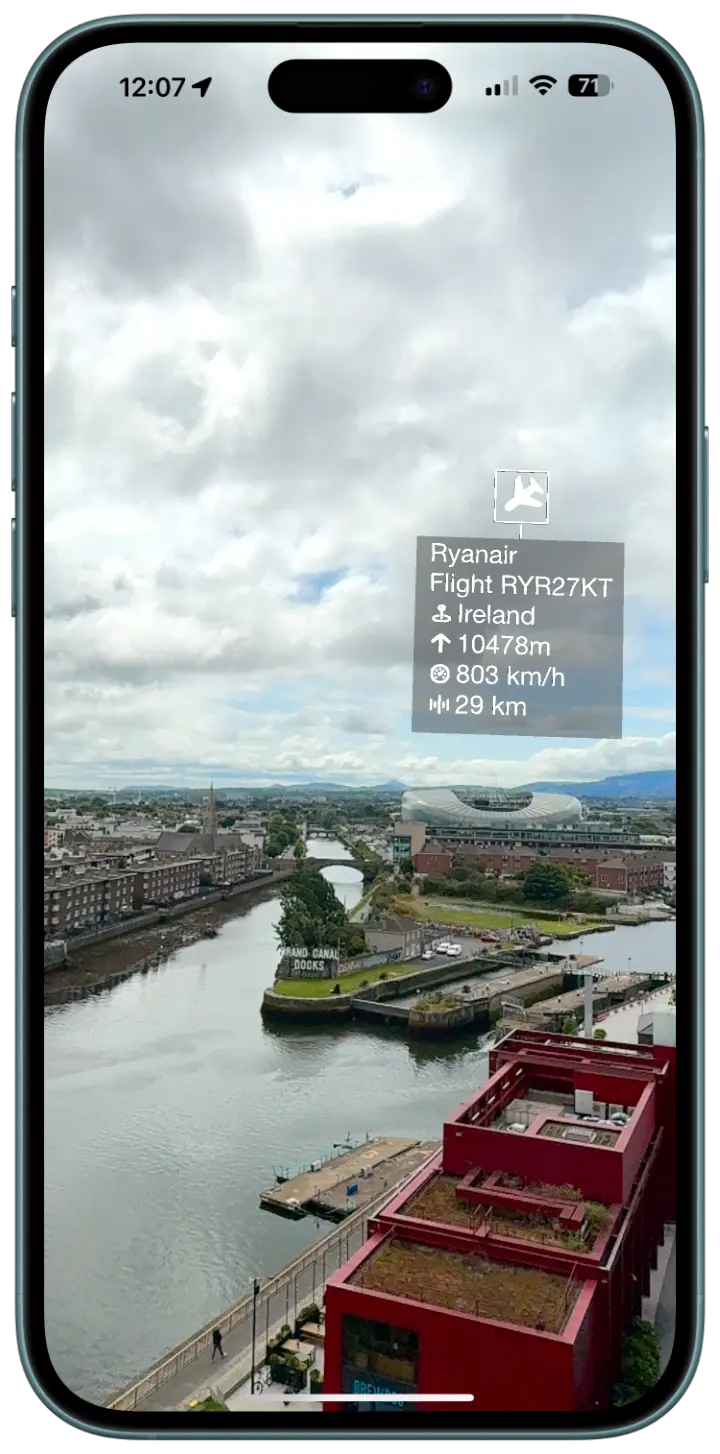
Over time it becomes a collection rather than a list: the airlines you have caught, the types, the countries, with twenty achievements built on top of it, three of them hidden. The best of them are the ones you cannot deliberately chase. And it all syncs to your own iCloud, so the record survives the phone.
Start today with a bad sighting. The collection is worth more than any single entry in it.
See what's flying above you. In augmented reality. For free.