From initial consultation to final layout, every design project starts with knowing the room. Scan it in 60 seconds and get to the creative part faster.
Ask any interior designer what the least creative part of their job is, and there is a good chance they will say measuring. Not because measurements do not matter -- they matter enormously -- but because the process of capturing them has always been tedious, error-prone, and disproportionately time-consuming relative to the value it adds.
The traditional workflow goes something like this: arrive at the client's home or office, pull out a laser measure and a notepad, methodically record every wall length, doorway width, window placement, and architectural feature. Sketch a rough plan. Go back to the office. Transfer the handwritten notes into CAD software. Realize something does not add up. Call the client. Schedule another visit. Remeasure the section that does not make sense. Finally produce the base plan that the actual design work can begin on.
This process can eat up an entire day for a single room. For a multi-room project, the measurement phase can stretch across multiple site visits before a single piece of furniture gets specified or a single color palette gets proposed.
Flooring It compresses this entire phase into minutes. Walk the room with your iPhone or iPad, let the LiDAR do the measuring, and export a dimensional floor plan that you can bring directly into your design workflow. No notebooks. No return trips. No numbers that refuse to reconcile.
The same LiDAR technology used in professional surveying, built into the iPhone and iPad you already carry.
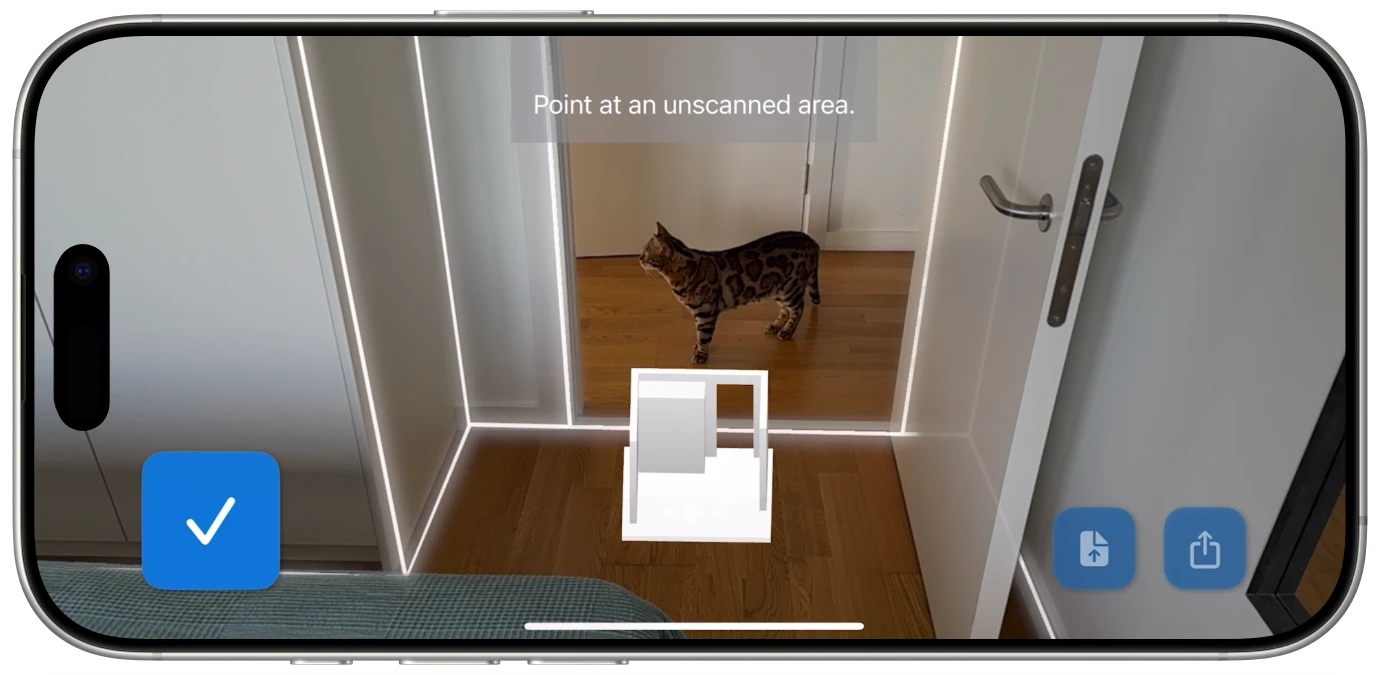
During the first client meeting, scan each room while discussing the project. By the time the conversation ends, you have measured floor plans for every space. No separate measurement appointment needed. The design conversation and the data collection happen simultaneously.
Teach your clients to scan their own rooms. They open the app, walk the space, and share the export with you. You get a measured floor plan without making the trip. This is especially valuable for remote clients or properties in other cities. The data is the same whether you scan it or they do.
Scan rooms at different stages of a project to document spatial changes. If walls are moved, built-ins are added, or room configurations change, a fresh scan creates an updated baseline. Comparing scans from different dates tells the story of how the space evolved.
One of the most powerful aspects of Flooring It for interior design is how it simplifies collaboration between designers and their clients. The traditional workflow requires the designer to visit the space, take measurements, return to their studio, and then begin the design process. It creates a bottleneck that delays the entire project.
With Flooring It, the measurement step can happen independently of the designer. A client can scan their rooms on their own schedule -- no coordinating calendars, no waiting for the designer's next available window. They walk each room, export the floor plans as PDF or SVG, and send them to the designer via email, AirDrop, or any file-sharing service.
The designer receives measured floor plans with dimensions on every wall segment. These are not rough sketches or eyeballed guesses. They are LiDAR-generated floor plans, consistent enough to lay a room out from. For the one or two spans a custom piece depends on, check them with a laser measure before anything gets ordered. The designer can begin layout work, furniture specification, and spatial planning immediately.
For clients, this is empowering. They are not waiting around for someone else to capture basic information about their own home. For designers, it is liberating. They skip the most tedious part of the process and jump straight to the work that actually requires their expertise.
Vector floor plans that import cleanly into Illustrator, Figma, SketchUp, and other design tools. Infinitely scalable. Always sharp.

For interior designers working in digital tools, the SVG export is where Flooring It really shines. SVG is a vector format, which means the floor plan can be scaled to any size without losing quality. Zoom in to see the detail of a single wall segment. Zoom out to see the full room layout. The lines stay crisp at every level.
More importantly, SVG files are editable. Import the Flooring It floor plan into Adobe Illustrator, Figma, Affinity Designer, or any vector editing tool, and you can work directly on top of it. Add furniture layouts. Annotate with material callouts. Layer in lighting plans. The scanned floor plan becomes the foundation that the rest of the design is built upon.
This is a significant improvement over the traditional workflow of manually redrawing a room in CAD or design software based on handwritten notes. The LiDAR scan captures the room's geometry accurately, and the SVG export preserves that geometry in a format that slots directly into a designer's existing tools. No transcription errors. No "was that 3.2 meters or 3.5 meters?" moments.
For designers who work in 3D software, the OBJ export provides a mesh that can be imported into SketchUp, Blender, or similar applications. This is useful for creating 3D renderings and walkthroughs that show clients how the finished space will look and feel.
A clean, professional floor plan with measurements. Include it in design proposals, mood boards, and client presentations.

There is a professional credibility gap between handing a client a hand-sketched floor plan with ballpoint measurements and presenting a clean, LiDAR-generated floor plan with dimensions on every wall. Both convey the same basic information. But one signals that you are working with professional tools and real data. The other signals that you are working with a tape measure and good intentions.
For designers who want to position themselves as modern, technologically fluent professionals, the quality of their measurement documentation matters. A LiDAR-scanned floor plan communicates rigour and care before a single design decision has been made. It sets the tone for the entire client relationship.
The accuracy difference is real, too. Hand measurements are subject to human error -- holding the tape at a slight angle, rounding to the nearest inch, forgetting to account for baseboards. LiDAR measures by bouncing light off surfaces, capturing geometry with a consistency that manual measurement cannot match. For design work where furniture needs to fit specific spaces and custom elements need dimensions you can trust, this consistency is not academic. It is the difference between a design that works in reality and one that only works on paper.
For solo designers and small firms, the time spent on measurement is time not spent on design, client development, or business growth. If every project starts with a half-day measurement session, that adds up to a significant portion of your working hours over the course of a year.
Flooring It changes the time equation. A room that takes 20 minutes to measure with a laser measure and notepad takes 60 seconds to scan. A three-room project that used to require a dedicated measurement visit can now be scanned during the initial client meeting. The time savings per project is modest. The cumulative savings across a year of projects is substantial.
For designers managing multiple concurrent projects, the ability to have clients self-scan their spaces is even more impactful. The measurement phase no longer requires the designer's physical presence, which means projects can move forward in parallel without the designer being the bottleneck.
A complete measured floor plan, ready to serve as the foundation for your design work.

During your initial client meeting, scan each room while discussing goals and preferences. The LiDAR captures walls, corners, and doorways as you walk. Most rooms take about 60 seconds. By the time you leave, you have measured data for every space.
Export as SVG for design software, PDF for presentations, or OBJ for 3D modeling. Each format serves a different stage of the design process. The SVG imports directly into Illustrator, Figma, or your tool of choice as a clean, editable base plan.
Build your design on top of accurate measurements. Specify furniture that fits. Plan layouts that work. Present to clients with floor plans that show you measured the room. When the dimensions are right, the design process flows.
Interior design is a creative profession that has always been anchored by a tedious measurement phase. Flooring It does not eliminate the need for accurate measurements -- if anything, it makes accuracy easier to achieve. What it eliminates is the time, friction, and error that traditional measurement methods introduce.
Scan a room in 60 seconds. Export an SVG for your design software. Share a PDF with your client. The measurements are done. Now do what you actually trained to do: design the space.
Flooring It requires an iPhone Pro (12 Pro or later) or iPad Pro (2020 or later) with LiDAR. It exports to PDF, SVG, USDZ, OBJ, Reality, and JSON formats. It is available in 23 languages.
Your next design project is one scan away from starting on the right foot.